

ECE wraps spring AI workshop series with inaugural showcase
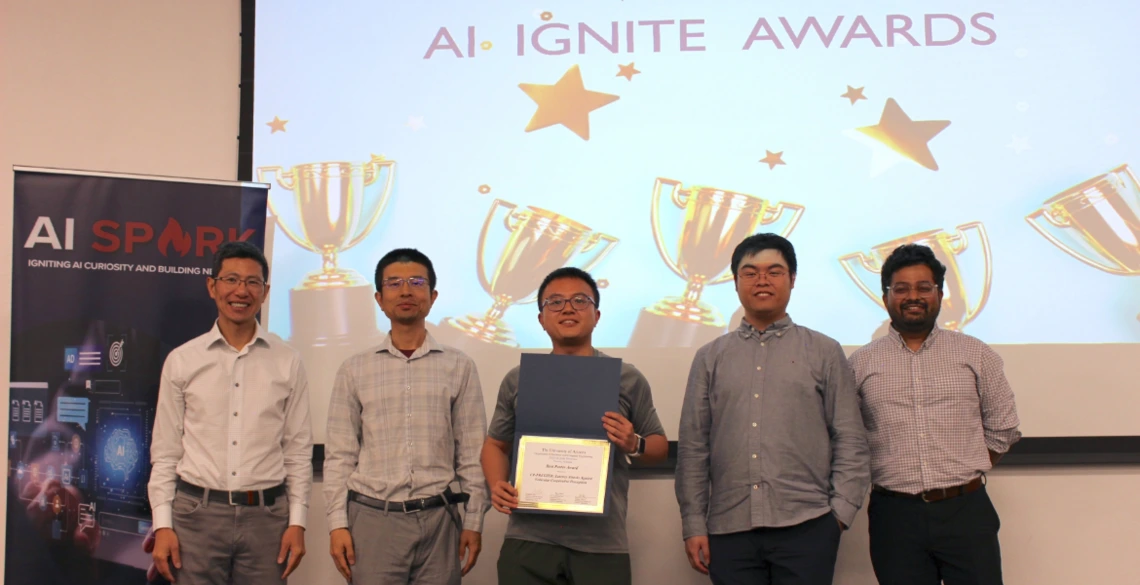
(From left) ECE department head Michael Wu, professor Ming "Fred" Li, PhD student and Best Poster Award winner Chenyi Wang, assistant professor Huanrui Yang and assistant professor Jyotikrishna Dass at AI IGNITE on May 5, 2026.
A University of Arizona electrical and computer engineering student took top honors at the first annual AI IGNITE Showcase on May 5, 2026. PhD student Chenyi Wang won the Best Poster Award for “CP-FREEZER: Latency Attacks Against Vehicular Cooperative Perception,” a project that improves situational awareness of connected and autonomous vehicles by exchanging and combining messages from multiple agents.
"Watching our students present their work alongside faculty doing cutting-edge research – that's what this department is all about," said Michael Wu, ECE department head and Thomas R. Brown Leadership Chair. "AI IGNITE gives everyone a stage, and our students rose to the occasion."
The showcase grew out of a spring semester of AI programming organized by ECE assistant professors Jyotikrishna Dass and Huanrui Yang. The event featured a poster competition along with lightning talks from Wu and ECE professor Ming "Fred" Li.
"The sparks leads to ignition," Dass said. "We wanted a showcase of the exciting things our students are working on – both in research and in course projects – and a way to wrap up the year where students get to learn from each other."
“This poster session was a great way to show off our course project,” said ECE student Matthew Aracarese. “Not a lot of people get to see the AI research we conduct in our classes."
AI SPARK workshop series
AI IGNITE was the culmination of a workshop series designed to make AI education accessible beyond the classroom. Dass and Yang co-designed the AI SPARK workshop series as a complement to ECE 425/525, a course the department now offers every semester. Faculty alternate roles each term: one leads the SPARK workshops while the other teaches the course, ensuring students have access to structured instruction and community learning year-round.
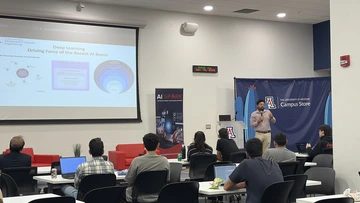
ECE assistant professor Jyotikrishna Dass walks participants through large language model concepts during an AI SPARK workshop.
"There's a very large campus community that really wants to learn about AI," Yang said. "That's why we wanted to offer a community workshop that introduces not only the basics of AI but also enables hands-on demos."
Dass taught the inaugural section of ECE 425/525 in the fall 2025 semester, while Yang kicked off the SPARK workshops that same semester with assistance from PhD student Yuanzhe Li. This spring, the roles shifted: Yang taught the course while Dass led the workshop series with help from PhD student Hariharan Ramesh.
“These workshops build a community of people who are interested in learning AI, who want to do something with AI and potentially turn their interest into a real product,” Dass said.
The series moved from theory to practice across its sessions, with attendees learning how to deploy open-source large language models in a hands-on, interactive environment, building on the foundations from the first workshop. Participants ranged from first-time AI explorers to experienced engineers.
“Seeing students go from zero experience to learning how to run their own LLM in a single session – that’s what makes this worth doing,” said Ramesh.
While SPARK sessions build foundational knowledge, IGNITE is where that energy pays off.
Poster winners
Best Poster Award
“CP-FREEZER: Latency Attacks Against Vehicular Cooperative Perception”
Chenyi Wang
Runner-Up Award
“MoBiQuant: Mixture of Bits Quantization for Token-Adaptive Elastic LLMs”
Dongwei Wang
People’s Choice Award
“DF-LoGiT: Data-Free Logic-Gated Backdoor Attacks in Vision Transformers”
Xiaozuo Shen
Honorable mention
“UAS Detection via Attention-Guided YOLOv8 with Efficient Convolution for Edge Compute”
Matthew Arcarese with collaborators Mahshad Akbarsharif and Henry Wang