

Powering quantum: U of A engineers collaborate on $4M NSF award
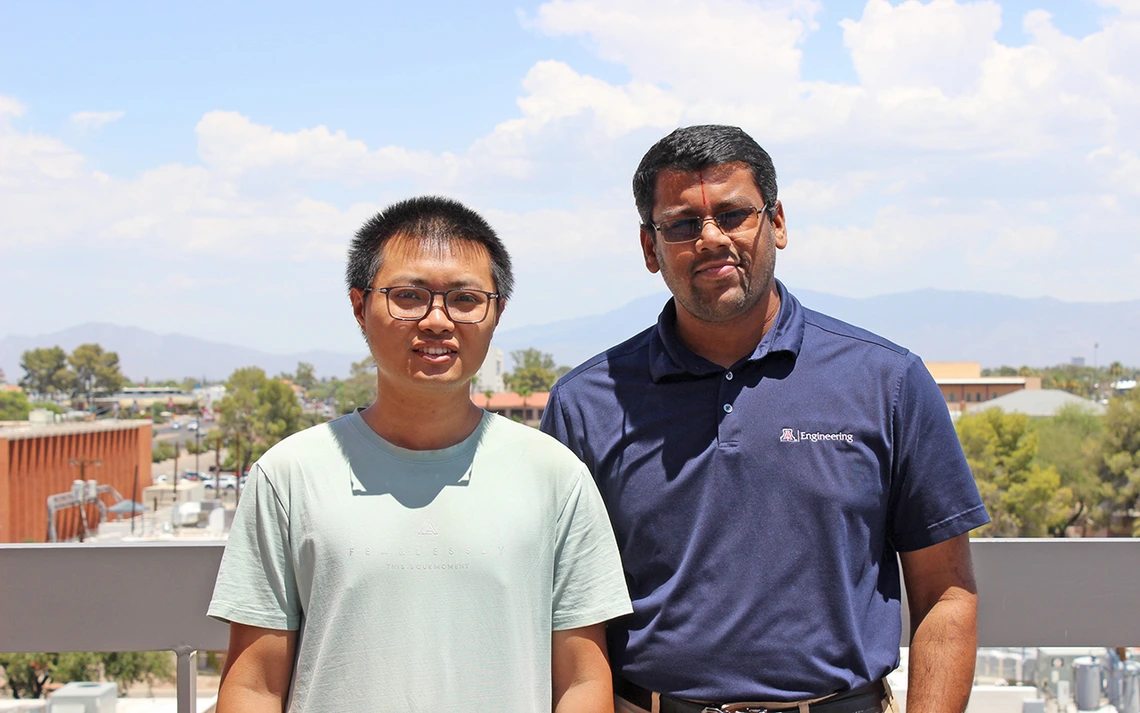
School of Electrical, Computing, and Software Engineering graduate student Zhuangzhuang Chen and assistant professor Narayanan Rengaswamy are developing error-correction codes for a UCLA-led team of quantum computing researchers.
The University of Arizona’s Narayanan Rengaswamy, assistant professor in the School of Electrical, Computing, and Software Engineering, is a core member of a University of California, Los Angeles-led team that won $4 million from the National Science Foundation to jumpstart quantum computing in the U.S.
The National Science Foundation selected the Accelerating Fault-Tolerant Quantum Logic group as one of nine teams in the National Quantum Virtual Laboratory (NQVL) design competition to tackle current challenges in quantum computing design and applications.
“Quantum computers will only become useful when they can operate reliably despite the fragility of quantum information,” said Eric Hudson, professor of physics and astronomy at UCLA and principal investigator of the project. “This award allows us to bring together the hardware, error correction, software and user communities needed to design a system that can reach the fault-tolerant regime.”
Rengaswamy and associate professor Yufei Ding in the Department of Computer Science and Engineering at the University of California, San Diego, co-lead the project’s quantum error correction pillar that will develop methods that increase the efficiency and reliability of quantum computers.
“I’m very excited to be working on this transformative project that lets us think full stack from algorithms down to the physics of the hardware,” said Rengaswamy. “I believe the work we are doing will speed quantum computing’s reliability to perform quantum simulation of various physical processes faster than any current classical computer.”
The NQVL brings together research on algorithms, compilation, error correction and architecture to improve the functionality of quantum technology for real-world applications.
Realizing limitless computing power
Quantum computing can increase computational speeds exponentially over classical computing. It manipulates subatomic particles called qubits to execute computations. Quantum computers use qubits to build logical gates that perform tasks, like those in classical computers. But quantum-level behaviors such as superposition and entanglement enable a quantum computer to process numerous computational possibilities at once, rather than one after another as classical computers do.
Quantum computing faces one major challenge, however: the fragility of qubits. Outside energy or particles can easily knock a qubit out of superposition and destroy the computation. To combat this fragility, quantum computers need strong error-correction capacity.
Logical qubits, which are used to perform calculations in a quantum computer, are protected from noise by encoding them into physical qubits that detect and fix errors. The research team is designing a quantum computer with fewer physical qubits per logical qubit, making the technology less error-prone while retaining its power.
“That will bring the current physical error rate down by at least an order of magnitude,” said Rengaswamy.
With 60 logical qubits and the reduced physical-to-logical qubit overhead, the computer will need far fewer physical qubits for error correction than quantum computers require now.
“For the computer we are building, that will mean 1,000 to 2,000 physical qubits, down from the 10,000 or more thought to be required,” said Rengaswamy.
To achieve this, Rengaswamy is programming error-correction mechanisms that manipulate logical qubits simultaneously. The design increases efficiency and is more likely to catch errors before mistakes spread to other qubits.
“The biggest difference is that previously people used to think of each logical qubit as needing its own code, but that’s not effective,” he said. “Instead of doing this qubit-by-qubit kind of encoding and error correction separately, you encode and decode error correction procedures jointly for all those 60 logical qubits.”
Graduate student Zhuangzhuang Chen is helping Rengaswamy with error correction. Chen created a mechanism for Trotter circuits, a common algorithmic building block, that encodes their action on multiple logical qubits simultaneously. The mechanism encodes fault tolerance into a block of logic gates simultaneously, rather than doing it gate-by-gate as in traditional approaches.
The quantum computer Rengaswamy and the team are building will serve as a testbed for academic and industry researchers. Chen hopes it will spark ideas and innovation from users.
“Sometimes you cannot imagine what will come out of new technology. There were a lot of things we predicted during the rise of classical computing, but a lot we didn’t,” he said. “Nobody thought we would be doing Zoom calls, for example, but these kinds of innovations come when you make new tools easily accessible.”